Whoa!
I kept finding myself clicking on transaction hashes late at night.
Really, somethin’ about unspun on-chain truth is oddly soothing.
Initially I thought explorers were just crude block logs, but then my view expanded after digging into token metadata, account histories and program logs.
As a frequent Solana user from the US who has built small tooling around parsing logs, my instinct said this would be simple, though it turned into a series of aha moments that changed how I audit token flows.
Here’s the thing.
Explorers are not glamorous. They are tools. Plain tools.
On one hand they show raw bytes and lamports moving around, and on the other hand they reveal the story behind a token transfer when you know how to read program logs, instruction data, and account state changes.
Actually, wait—let me rephrase that, because some explorers also synthesize the data into user-friendly token pages and indexed analytics, which matters a lot when you’re tracking emergent tokens and suspicious transfers.
Hmm…
Sometimes I skim the token holder list like it’s a guest list for an exclusive party.
My gut tells me that a few addresses will always dominate early holders, and that often signals a centralized distribution or a pre-mine.
At first I underestimated how often a token’s initial holder distribution predicts future rug risks, but reviewing on-chain histories has corrected that bias repeatedly.
Whoa!
Block explorers are part ledger and part microscope.
They let you zoom from cluster-level block times down to the inner instructions of a swap or mint—fast and precise if the explorer indexes everything properly.
When the indexer misses something, though, you get gaps, and those gaps can mask clever contract behavior that steals funds or hides liquidity drains.
Here’s the thing.
Not every explorer is built the same way; some prioritize speed while others prioritize completeness and historical depth.
I’m biased, but I prefer explorers that show program logs and decoded instructions inline because those are the signals I use to make decisions quickly while troubleshooting issues for users.
On the flipside, faster explorers with simpler UI are great for non-technical folks who just want to verify a transfer, so there’s a trade-off between depth and accessibility.
Really?
Yes, really—features matter.
Look for things like a token tracker page, holder distribution charts, historical minting events, and a clear display of delegated authorities; these are must-haves in my book.
When a token page hides minting or renounces authority without clarification, that part bugs me because it creates ambiguity that can be exploited by bad actors.
Whoa!
I still run manual checks, even when the explorer provides fancy analytics.
Sometimes automated labels are wrong, very very wrong, and you have to inspect raw instructions to confirm what’s actually happening inside a transaction.
On one hand automation helps flag suspicious transfers quickly; though actually reading the payloads yourself is the only way to be absolutely sure that a swap wasn’t executing a malicious program call under the hood.
Here’s the thing.
Explorers with API access make my life easier.
When I’m building a small dashboard or verifying wallet activity, an API that returns decoded instruction sets and token balances speeds up the process dramatically.
That API access becomes essential when you need to pull historical token holder snapshots or to replicate an account’s transaction graph for compliance or audit purposes.
Hmm…
Privacy matters, too.
Although Solana addresses are pseudonymous, on-chain activity links actions in surprisingly obvious ways if you know what patterns to look for.
My instinct said early on that mixing services would add cover, but after seeing patterns repeatedly I learned that clustering heuristics can uncover layered relationships across wallets and contracts.
Whoa!
Token trackers are the unsung heroes for NFT projects and DeFi tokens alike.
They show who minted the tokens, whether the supply is fixed, and how liquidity pools were seeded—details that directly influence trust and price behavior.
When projects hide initial mint addresses or obscure liquidity provisioning, it increases the risk for ordinary users who assume fair distribution by default.
Here’s the thing.
If you’re chasing suspicious transactions you need filtered views: transfers only, programs only, failed transactions, inner instructions, and memos.
Filters save you time by cutting out noise, but only if the explorer supports granular filtering on program IDs and instruction types; otherwise you’re swimming upstream reading irrelevant noise.
In practice, being able to export that filtered view as CSV or to hit an API for bulk retrieval is what turns detective work into reproducible analysis, especially when you’re collaborating with a team.
Really?
Yes—labels and community-sourced annotations are powerful, but they can be misleading.
Labels often reflect consensus or attribution from earlier incidents, and sometimes those attributions are speculative rather than definitive.
Initially I trusted labels too much; later I learned to cross-check the raw history and program interactions before accepting any label as truth.
Whoa!
Solana’s parallelized runtime makes transaction tracing different from other chains.
Because instructions may run concurrently across accounts, the ordering you see in a single block requires careful interpretation to understand causality.
That nuance means that explorers which visualize instruction flow and account dependencies help avoid false assumptions about what triggered what during a complex multi-instruction transaction.
Here’s the thing.
User experience matters for adoption.
Some explorers feel like reading a legal brief, and that puts casual users off; others dumb things down so far that power users can’t get the detail they need.
Balancing clarity and depth is hard, and the best projects give you both: a clean default UI with toggles for advanced diagnostics and raw data access when you want to nerd out.
Hmm…
I keep thinking about integrations.
Wallets, portfolio trackers, block builders, and alert services all rely on solid explorer backends to function reliably during market stress.
When an explorer’s indexer lags during a congested period it cascades into bad UX for all those integrated services, which is why uptime and resync strategies matter a lot.
Whoa!
For devs, program logs are gold.
They reveal errors, gas usage, and custom event emissions, and they often point directly to the failing instruction during a failed swap or cross-program invocation.
When you’re trying to troubleshoot a user complaint at 2am, being able to inspect program logs in context saves time and reduces bad support calls, which is surprisingly satisfying.
Here’s the thing.
Trustworthy explorers guard against spoofing and phishing via clear linkouts and verified project badges.
But badges are social constructs—someone has to curate them—and that curation can lag behind new scams that mimic legitimate UIs or token names.
So cross-check token mint addresses manually if something smells off, because the UI alone shouldn’t be your only defense.
Really?
Yes, and here’s a practical tip.
Copy and paste the mint address into the explorer search bar and compare its creation and mint history; check who initially funded the mint and who received early allocations.
That small ritual will flag many bad actors before you interact with a token, and honestly it’s a habit I wish more people had.
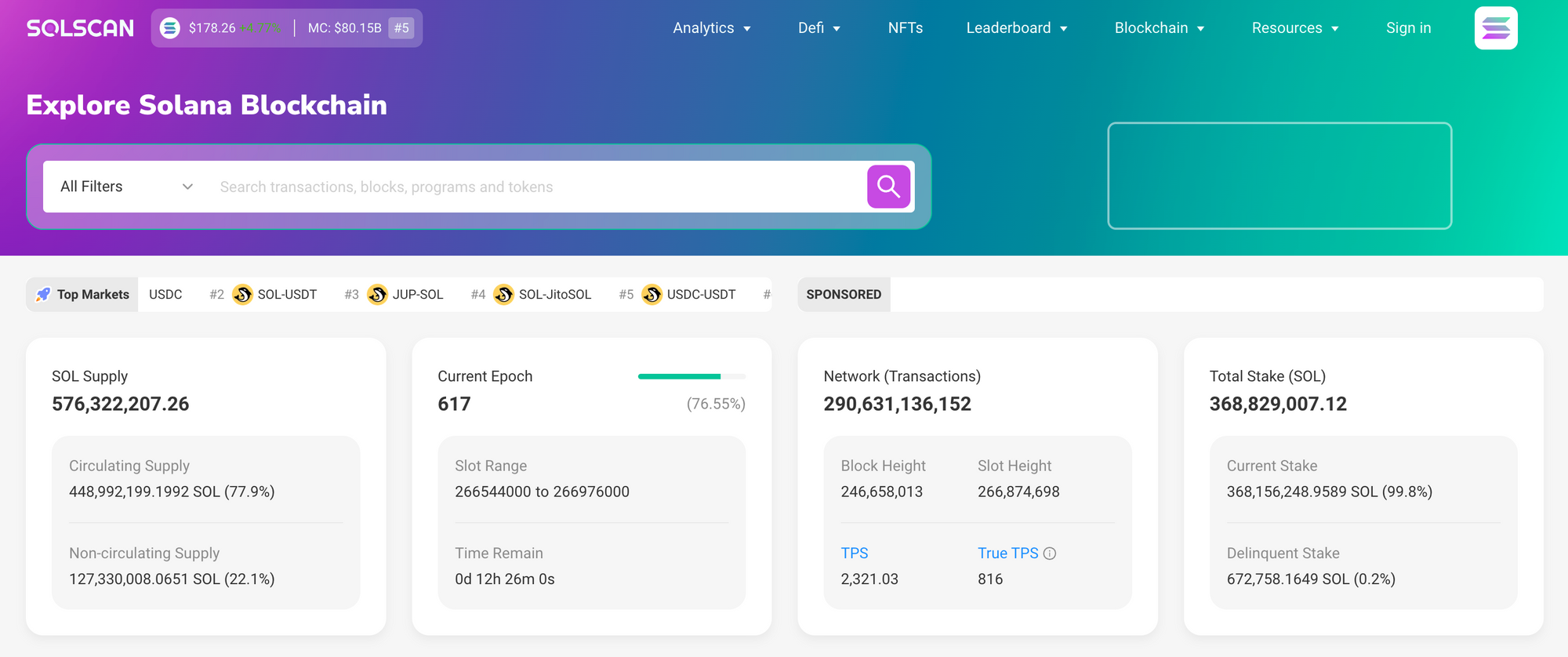
Where to start if you want a reliable Solana explorer
If you want a practical place to begin, try a well-regarded explorer like solscan for its token pages and decoded instruction views; then complement it with program-log-friendly views and an API-backed tool when you need bulk analysis.
I’m not saying it’s perfect—nothing is—but pairing a user-friendly interface with raw-log access gives you both quick answers and deep evidence when you need to prove a claim or debug a failure.
Oh, and by the way, keep bookmarks for a few explorers; different ones will catch different edge cases, and sometimes cross-referencing between them uncovers inconsistencies that are meaningful.
Whoa!
Final thought—this is messy and human, which I like.
Explorers are a public good that we all rely on, and they improve when users report issues, suggest features, and build tools on top of indexed data.
I’m not 100% sure how all indexing strategies will evolve as Solana matures, but I know good explorers will keep adapting because the chain rewards speed, clarity, and resilient indexing.
FAQ
Q: How can I verify a token is legitimate?
Check the mint address history, review initial holder distribution, inspect program logs for suspicious mint instructions, and confirm whether the project has a verifiable website or whitepaper; labels help but always cross-check raw data.
Q: What features should I look for in an explorer?
Look for decoded instruction views, program logs, token holder analytics, CSV export or API access, granular filters, and clear labeling systems; these features help both casual users and power auditors uncover what’s actually happening on-chain.